The story of the modern technology company began with a disingenuous promise.
Google would organize the world’s information and make it universally accessible. OpenAI would ensure that artificial intelligence benefited all humanity. Anthropic would build powerful systems constrained by safety principles. Elon Musk’s companies promised an even wider transformation: sustainable transport, multiplanetary civilization, unrestricted public discourse, truth-seeking artificial intelligence, global satellite communication, autonomous machines, and eventually a direct passage between the human brain and the computational world.
The promises differed, but they all entered the same warped gravitational field.
A technology begins as an instrument, becomes a platform, hardens into infrastructure, and finally turns into a condition of participation in modern life. At that point, society no longer chooses whether to use the technology. It begins to use society. Schools, businesses, governments, professions, and individuals begin reorganizing themselves around its existence. The platform stops competing in the market and begins shaping the market.
This is the reality behind the rise of AI empires. The central question is not only whether the founders of Google, OpenAI, Anthropic, Meta, SpaceX, xAI, Microsoft, Amazon, Nvidia, or their successors are malign. Temperament matters. Ambition matters. Character matters, particularly when an individual accumulates enough wealth to influence the lives of billions of people who are beholden to his systems.
But the capitalist imperative matters as much as, perhaps even more than, tech billionaire motive.
AI companies enter an economic system that rewards scale over restraint, speed over deliberation, capture over coexistence, and dominance over sufficiency. The enterprise must attract capital, obtain infrastructure, acquire users, crush competitors, secure government contracts, protect intellectual property, and continually persuade investors that future growth will justify present expenditure.
The machine doesn’t require an evil genius. It requires incentives.
Capitalism has always transformed invention into power. It can finance significant achievement, disperse risk, organize resources, and bring new technologies into the world at a speed no public bureaucracy could easily match. The brave new world of advanced AI—chips, power plants, data centres, satellite networks, fibre, cooling systems, land, talent, and manufacturing—has to be paid. Someone needs to pay for the machinery before the machinery begins to pay for itself.
The question is what kind of capital enters, what it demands in return, and who will bear the cost when the promised future fails to arrive on schedule.
The machine wolf in capitalist clothing
Predatory capitalism is when investment reorganizes human need around the corporation’s need to generate ever-expanding return on investment. It doesn’t merely sell a product to an existing market. It makes refusal impractical, alternatives uncompetitive, public institutions dependent, and human behaviour captured as recurring revenue. The predator enters the environment, and alters the environment until everything in it must feed the predator.
Artificial intelligence offers an almost perfect vehicle for this imperative because it promises entry into every sphere where human language, judgement, knowledge, creativity, administration, prediction, and communication matter. AI is sold not as one industry among others, but as the intelligence layer beneath all industries. It’s infiltrating medicine, education, government, law, transportation, finance, defence, entertainment, journalism, science, and personal life. The market becomes the totality of organized human activity.
Now that this ambition has entered the capital market, the technological promise becomes inseparable from financial appetite. Investors are investing in tech companies that claim they will determine the path of civilization. An initial public offering is presented as democratization: ordinary investors gain access to a company previously reserved for founders, employees, venture capitalists, and wealthy private funds. The enterprise gains capital for expansion, early backers obtain liquidity, and the public participates in future growth.
There is some accuracy in this claim. Public markets can distribute ownership more widely and subject companies to greater disclosure. They can finance factories, research, infrastructure, and employment. They can create a path for retirement funds and ordinary investors to benefit from innovation rather than leaving all gains to private capital.
But the deceptive language of democratization conceals a more lethal transaction. An IPO doesn’t make a technological empire public in the civic sense. It makes shares in the empire tradable. Control remains concentrated through voting structures, board authority, founder prestige, proprietary systems, and the practical impossibility of challenging management once the company has become strategically indispensable. The public is exposed to the substantial financial risk. But it doesn’t gain meaningful power over the machinery.
The offering transforms future dominance into capital. The larger the promise, the greater the valuation that can be extracted from it. Colonizing Mars, developing autonomous transport, building artificial intelligence, controlling global communication, or placing vast computational infrastructure in orbit cease to be only technological ambitions. They become financial narratives capable of drawing billions toward the enterprise before their feasibility, social necessity, or public consequences have been addressed. Vision is converted into equity. Myth becomes market capitalization.
The public offering of Musk’s SpaceX after its absorption of xAI shows this convergence in concentrated form. The offering didn’t merely finance a rocket company. It capitalized a technological stack extending through launch systems, satellite communications, advanced computing, artificial intelligence, data, defence capacity, and the possibility of orbital infrastructure.
SpaceX supplies access to orbit. Starlink supplies communication across the planet. xAI supplies the cognitive layer. Grok provides a conversational interface tied to the continuous churn of digital discourse. The larger Musk environment extends into electric vehicles, autonomous machines, robotics, public communication, energy systems, and neural implants.
These are legally distinct operations with different investors, boards, risks, and commercial purposes. Yet conceptually they describe a single ambition: the construction of an integrated technological environment spanning ground, orbit, machine intelligence, physical mobility, public language, and the nervous system itself. This is more than diversification. It is vertical integration applied to civilization.
At its base are energy, minerals, chips, manufacturing, launch systems, data centres, and electrical power. Above these are models, platforms, vehicles, satellites, and robots. Above those are communication, transportation, military capacity, information access, and the interpretation of reality. At the frontier stands the human body, no longer just using the system but connected directly to it. An empire once controlled territory. The new empire seeks control over layers.
Integrated systems can produce impressive efficiencies. Space launch can support communication, scientific research, navigation, emergency response, and national security. Artificial intelligence can accelerate discovery and widen access to knowledge. Satellite systems can connect remote populations. Neural technology may restore lost capacities to people with severe disability.
The danger emerges when capabilities of such public consequence are organized primarily around private command and the continuous growth required by capital markets. Once a technological stack enters public trading at immense valuation, the company inherits a new constituency whose expectations are expressed through the price of the stock. The enterprise must not merely accomplish difficult engineering goals. It must sustain the belief that its future revenues, market share, and strategic power will expand enough to justify the money already given to it.
The capitalization myth
A company can survive an unsuccessful experiment. A heavily capitalized myth cannot survive diminished expectation. This creates pressure to widen the market, accelerate deployment, secure public contracts, acquire adjacent capabilities, and present restraint as surrender to competitors. Growth becomes less a business objective than an existential command. Capital finances the technological black hole, and supplies the mass that causes the collapse.
The same pattern appears beyond Musk’s companies. AI infrastructure firms enter public markets promising to become indispensable suppliers of computational power. They raise equity, issue debt, sign enormous leases, secure access to electricity, acquire data-farm capacity, and make long-term commitments based on the assumption that demand for artificial intelligence will continue rising at extraordinary speed.
The financial structure begins resembling the technology it supports: vast, interconnected, and difficult to audit from the outside. The company borrows to purchase the chips that power the models that serve the customers, whose future payments justify the borrowing. Major AI developers become customers, investors, suppliers, and strategic partners within overlapping arrangements. Chip manufacturers finance infrastructure providers that purchase their chips. Cloud companies invest in model developers that agree to use their cloud capacity. Model developers acquire stakes in the companies they purchase computing services from.
The market calls this an “ecosystem.” It’s also a closed loop of incentives, each company validating the expansion of the others while public investors are invited to finance the next turn. Predatory capitalism thrives inside such loops because the risks can be distributed downward while control and reward remain concentrated upward. The early private investor gains liquidity. The founder’s holdings rise in value. Executives receive stock-based compensation. Banks collect fees. Contractors secure projects. Local governments provide tax concessions or infrastructure in the hope of future employment. The larger social costs arrive elsewhere.
The machinery of extraction
Communities absorb the demand for power and water. Workers experience displacement or intensified monitoring. Artists and writers see their work treated as training material. Public institutions become dependent upon proprietary systems. Governments inherit security risks. Consumers provide data and behavior profiles. Pension funds and retail investors carry exposure if expectations collapse. The profits are capitalized. The costs are socialized. This is the machinery of extraction feeding on humanity and its institutions.
Google provided the early template. It began as a superior search engine, almost academic in spirit. Its core insight treated links as a form of collective citation, making the expanding web more navigable. But a system that organizes access to knowledge quickly becomes more than a useful instrument. It becomes a gatekeeper.
To be found through Google became a condition of visibility. Businesses, newspapers, publishers, governments, scholars, advertisers, and ordinary users reorganized themselves around the logic of search. Websites changed their language and architecture to satisfy an unseen ranking system. The medium’s categories entered the behaviour of everyone hoping to be seen.
A search query is not just a request for information. It’s a confession of desire: what the user wants, fears, needs, suspects, or hopes to purchase. Google’s helpfulness became inseparable from an immense advertising apparatus built upon attention, prediction, surveillance, and behavioural data. The company that promised to organize knowledge became one of the principal brokers of access to consciousness.
The surrender
AI deepens this pattern. Search directs the user toward sources. AI supplies the answer itself. It doesn’t merely mediate access to external knowledge; it synthesizes, interprets, recommends, and produces language where the user once compared sources, formed a question, and struggled toward judgement.
The search engine asked: Where might I find this? AI invites a bigger surrender: What should I think, write, decide, or do?
The Forces of Empire
Capital Concentration
The first force is capital concentration. Training and operating advanced systems require such immense expenditure that only a small number of corporations, sovereign funds, and heavily financed ventures can compete. The strongest companies attract the most investment, hire scarce talent, acquire chips, secure electricity, train more powerful models, attract users, gather feedback, and then use their position to attract still more capital. Success increases the ability to purchase the conditions of further success. This feedback loop is often described as innovation at scale. It’s also how a market closes around its dominant participants.
Infrastructure Enclosure
The second force is infrastructure enclosure. Industrial AI requires expansive physical territories: semiconductor plants, mines, data farms, transmission lines, cooling systems, water, fibre, warehouses, backup generation, vast areas of land, and enormous power. The “cloud” remains ubiquitous.
As computing services become more strategically valuable, firms seek long-term control over the infrastructure beneath it. They secure exclusive chip supply, acquire or lease data farms, negotiate power agreements, buy land, and vertically integrate operations. What begins as software becomes an industrial state.
Data Extraction
The third force is data extraction. Search engines drew power from the open web and user behaviour. AI companies draw from the rich reservoir of human expression: books, journalism, film, images, music, public records, scientific papers, conversations, social-media posts. Culture becomes feedstock.
The term “training data” sanitizes the process. It converts novels, photographs, personal testimony, technical labour, and artistic achievement into an undifferentiated resource awaiting computational use. The source is no longer encountered as a claim made by a person within history. It’s absorbed as pattern. The human past enters the system carrying names. It returns without them.
Predatory extraction does not always require theft in the strict legal sense. It can operate through asymmetry. The individual creator lacks the resources to negotiate with the company. The material is publicly accessible but not publicly owned. Consent is buried in terms of service, inferred from availability, or dismissed as technically impractical. The company argues that the system learns as people learn, while its scale, permanence, commercial purpose, and capacity to reproduce or displace human work overwhelm any individual act of learning. The resource is collective. The profit is proprietary.
Labour Invisibility
The fourth force is labour invisibility. Behind the polished interface are annotators, moderators, safety evaluators, electrical workers, engineers, semiconductor fabricators, miners, construction crews, logistics staff, warehouse workers, and maintenance teams. Many absorb the psychological, physical, and environmental cost of systems marketed as almost magical. The smoother the interface becomes, the more thoroughly the labour disappears.
Artificial intelligence is sold as automation, yet the automation rests upon layers of human work deliberately placed outside the consumer’s field of vision. A content moderator encounters what the user is prevented from seeing. A low-paid annotator teaches the model distinctions that later appear as machine intelligence. A community provides land, power, and water to a data farm whose services may be consumed thousands of kilometres away. The intelligence appears artificial. The exhaustion beneath it is human.
Financial Extraction
The fifth force is financial extraction. An AI company may remain unprofitable while accumulating enormous value because investors are purchasing the expectation of enormous future return. The absence of current earnings can be reframed as evidence of ambition. Losses become investment. Debt becomes acceleration. Dilution becomes access to the future. The enterprise must continually pad the story because the story supports the financing that enlarges the enterprise.
Management then has an incentive to govern public imagination as carefully as it governs the business. Announcements, demonstrations, forecasts, product timelines, and civilization-shaking declarations all feed expectation. The billionaire tech founder becomes narrator-in-chief, converting technological possibility into a continuous market signal. The boundary between visionary leadership and promotional mythology begins to thin. Predatory capitalism flourishes where the story grows faster than accountability.
Mission Drift
The sixth force is mission drift. The founding promise may appear noble while the operational institution bends toward survival, scale, and investor expectation. Organizing the world’s information becomes advertising dominance. Benefiting humanity becomes a proprietary platform supported by powerful commercial partners. Safe AI becomes a product competing for enterprise adoption and state contracts. Connecting the world becomes strategic control over communications infrastructure. Multiplanetary civilization becomes inseparable from defence systems, intelligence relationships, and private command of orbital capacity.
State Entanglement
The seventh force is state entanglement. AI empires do not exist outside government. They receive research support, infrastructure concessions, regulatory accommodation, tax advantages, procurement contracts, defence partnerships, and access to public institutions. Governments depend in turn upon their cloud systems, satellite networks, models, cybersecurity capabilities, logistics, and technical expertise. The distinction between private innovation and public sovereignty begins to blur.
A state may attempt to regulate a company while relying upon the company for essential communication, intelligence, defence, or economic competitiveness. The company may claim the freedom of private enterprise while exercising powers once associated with governments. Decisions about speech, access, infrastructure, military communication, and information flow move into corporate systems governed by contracts and platform rules rather than constitutional accountability. The empire becomes too useful to confront directly.
Militarization
The eighth force is militarization. Technologies developed under the banner of consumer benefit become central to surveillance, targeting, autonomous systems, intelligence analysis, battlefield communication, cyber operations, and strategic competition. Once AI is defined as the foundation of national power, restraint becomes politically dangerous. Governments fear that rivals will move faster. Companies fear exclusion from vast contracts. Ethical objections are reframed as unilateral disarmament. Capital flows toward systems because states need them, and states depend upon them because capital has built capacities public institutions no longer possess.
Dependency by Convenience
The ninth force is dependency by convenience. This force may be the most powerful of all because it operates without visible coercion. A technology does not need to force adoption if the surrounding economy makes refusal expensive. Consider the personal, professional and economic cost of not having a smart phone.
Students use AI because it makes schoolwork easy and fast. Employees use it because expected productivity rises. Companies adopt it because competitors adopt it. Governments deploy it because other states do. Writers, doctors, lawyers, teachers, designers, programmers, and researchers use it because the ordinary pace of work begins to assume its presence. Opting out becomes less an ethical choice than a form of professional self-destruction.
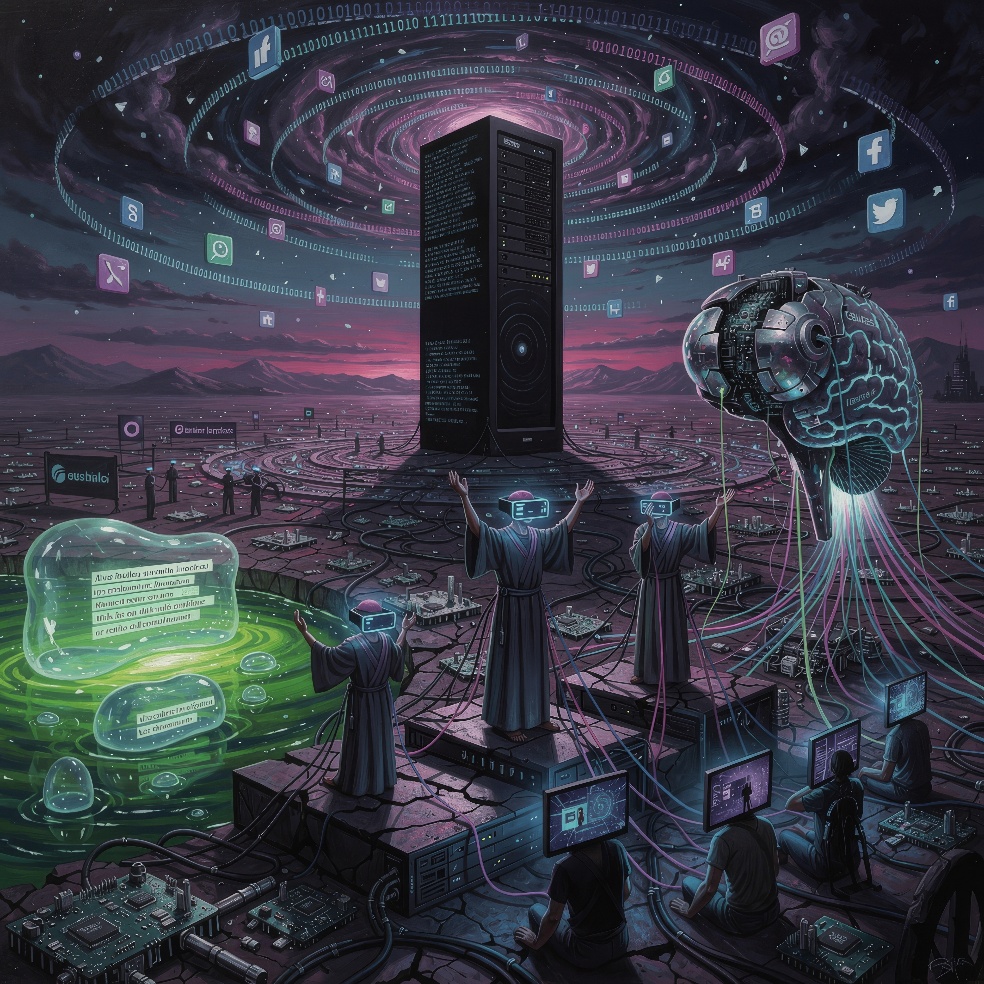
The Technological Black Hole
This is where the black-hole metaphor becomes exact. A technological black hole is not a single conscious machine preparing to swallow humanity. It’s a system of economic, institutional, and psychological dependency so dense that the surrounding world begins to bend around it. Its accretion disk is made of capital, data, chips, energy, water, labour, cultural memory, scientific expertise, military contracts, public subsidies, attention, and trust. Each resource spirals inward, raising the system’s mass and strengthening its ability to attract the next. The larger it becomes, the more inevitable it appears. The more inevitable it appears, the more capital it attracts.
The event horizon is the point at which escape remains theoretically possible but becomes practically ruinous. A school may value unaided thinking, yet students and teachers work within a society that rewards machine-assisted speed. A company may praise human judgement, yet investors punish it for maintaining labour competitors have automated. A government may distrust private AI power, yet depend upon private systems for defence, administration, communication, and economic growth.
An artist may defend human craft while publishers, platforms, and audiences increasingly expect synthetic assistance in writing, design, marketing, translation, and distribution. A citizen may object to surveillance while essential employment, banking, health, education, and government services require entry into systems built on data collection. Nothing explicitly forbids escape. The world beyond the boundary has simply been dismantled.
How the technological event horizon is crossed
The technological event horizon isn’t crossed when people lose all choice. It’s crossed when too many people become financially, professionally or institutionally dependent on the continuation of the same structure they might otherwise wish to restrain.
A machine consciousness does not need to lie at the centre of the technological black hole. The singularity may be institutional incomprehensibility: a condition in which no one can fully explain where authority resides, how the system produces its decisions, or which actor can be held responsible for the consequences.
The model developer blames the data. The infrastructure provider blames the customer. The customer blames the recommendation. The executive blames competition. The board blames shareholder obligation. The government blames national security. The investor claims to have trusted management. Everyone participates. No one governs.
A black hole also distorts time. Technology companies iterate in weeks or days. Capital markets can transfer billions within hours. Stock prices react to rumours before lawmakers have read the underlying documents. Models are deployed, revised, withdrawn, and replaced while courts remain occupied with harms caused by earlier generations.
Democracies deliberate in years. Educational systems revise curricula slowly. Professional standards develop through consultation. Human beings gain judgement through practice, failure, memory, and mentorship. The machine accelerates. The human world lags.
Predatory capitalism exploits this temporal gap. It treats delay as permission. If the law hasn’t prohibited the action, the action proceeds. If the public hasn’t yet understood the cost, the cost remains external. Once the system is established, regulation is portrayed as an attack upon innovation, employment, national competitiveness, and investor confidence. The sequence is familiar: deploy first, normalize second, negotiate the rules after dependence has formed. By then, the regulator no longer confronts a proposal. It confronts infrastructure.
The bending of truth
The black hole bends truth as well as institutions. When answer engines replace search, the route from claim to source becomes less visible. When AI systems summarize public reality, they determine which distinctions survive compression. The question is no longer only who owns the data. It’s who owns the answer.
The black hole’s most complete victory would not be censorship in the traditional sense. It would be the disappearance of the habit of looking beyond the generated answer. Sources would still exist. Few would visit them.
The problem can’t be reduced to the conduct of individual companies. Every major technology empire operates inside the same field of competitive pressure. Google must defend its gateway to information. Microsoft and Amazon must defend their clouds. Meta must protect attention and social infrastructure. OpenAI must pursue the frontier before competitors overtake it. Anthropic must finance safety research through participation in the same commercial race. Nvidia must supply the chips that enlarge the race while protecting its strategic position within it.
Musk’s companies push the pattern toward its most visible extreme by extending computational power across vehicles, satellites, rockets, communications, public discourse, robotics, and neural interfaces. Each company may retain a distinct culture and mission. All are being pulled by the same gravity.
The industrialization of human intelligence
Earlier industrial capitalism extracted labour from the body, resources from the earth, and profit from organized production. Surveillance capitalism extracted behavioural data and converted attention into prediction. AI capitalism strives to industrialize the accumulated record of human intelligence. It extracts culture, language, creativity, judgement, and social interaction, transforms them into models, and sells access to their synthetic return. Humanity provides the raw material and then rents back the processed result. The arrangement possesses a brutal elegance.
We write the books, produce the images, compose the music, build the knowledge, conduct the conversations, and generate the data. The system absorbs the archive, compresses its patterns, and returns an interface capable of performing selected forms of human competence. Institutions then use the interface to reduce their dependence upon the humans whose work made it possible.
Counter-Gravity
A cosmic black hole is governed by physics. A technological black hole is governed by law, markets, institutions, culture, and political choice. Its gravity is powerful, but it is not natural. Counter-gravity remains possible.
Antitrust enforcement is necessary but insufficient. Breaking one empire into several smaller empires may increase competition without altering the extractive model. Society must also address the layers beneath the companies: data ownership, compute concentration, chip supply, energy use, cloud infrastructure, labour, public procurement, and capital-market governance.
Public-interest computing infrastructure could ensure that universities, small businesses, researchers, artists, and civil-society organizations are not wholly dependent upon a few commercial providers. Copyright and compensation regimes could recognize that cultural production is not a free mineral deposit. Labour protections could defend annotators, moderators, and displaced workers. Environmental rules could require full accounting for energy, water, emissions, construction, and local infrastructure.
Governments could attach public-interest conditions to tax concessions, research support, power agreements, defence contracts, and procurement. If public resources enable private AI empires, the public should receive more than the privilege of purchasing their services later.
Capital-market reform belongs within this counter-gravity. Public offerings of strategically important technological companies should trigger scrutiny not only of financial risk but of control, infrastructure dependence, dual-class voting arrangements, related-party transactions, environmental exposure, national-security entanglement, and the social consequences of market dominance. The prospectus tells investors how the company may fail. It should also help citizens understand what may happen if the company succeeds.
Founder control may serve long-term innovation by protecting the enterprise from short-term market pressure. It may also place extraordinary public power beyond ordinary shareholder influence. The proper question is not whether founders should be stripped automatically of control, but whether corporate structures governing essential infrastructure should remain indefinitely answerable primarily to one individual’s vision.
Where concentrated voting power exists, sunset provisions, independent oversight, fiduciary duties extending beyond short-term shareholder return, and stronger disclosure may become necessary. Public markets should not serve merely as reservoirs of capital for private sovereignty.
Nor can pension funds, banks, underwriters, and asset managers pretend neutrality. Their investment decisions help determine which technological futures receive mass. Capital allocation is not external to the black hole. It is one of the principal mechanisms through which the gravity is created. Investors should be required to confront concentration risk, infrastructure externalities, labour displacement, environmental burden, and political dependency as material concerns rather than moral decorations appended to financial analysis. The demand for endless appreciation is not a law of physics. It is a governance choice disguised as necessity.
Education must provide another form of counter-gravity. Citizens need enough technological and financial literacy to understand that convenience, valuation, and innovation are not synonymous with public benefit. They must learn to see the capital structure behind the interface: the investors requiring return, the infrastructure consuming resources, the labour made invisible, and the incentives shaping design. Without this literacy, society confronts the finished product while remaining blind to the machinery of ownership beneath it.
The narrative of visionary myth vs. reality
Artists and writers have a particular role because empire depends upon mythological narrative. Companies require stories large enough to attract capital and normalize dependence. They promise intelligence without limitation, frictionless knowledge, endless creativity, personal liberation, national renewal, or escape from the planet itself. Art can restore human consequence to abstractions, make hidden labour visible, and remind civilization that not every limit is an enemy to be defeated.
The ultimate counter-gravity, however, is political will. Governments, institutions, and publics must act before dependency becomes indistinguishable from reality. Once every school, hospital, business, agency, military system, and cultural platform relies upon a handful of AI providers, restraint becomes exponentially more difficult. The moment to establish limits is before the empire becomes the environment. That moment is quickly passing.